Laser-Cut Triplex Business Cards with a Translucent Centre
€200.00excl. VAT€248.00incl. 24% VAT
Two coloured outer papers bonded around a printed translucent centre, with a controlled internal laser-cut window and one selected hot-foil colour on both outer faces.
A LAYERED PAPER SYSTEM
Colour outside. Printed translucency inside.
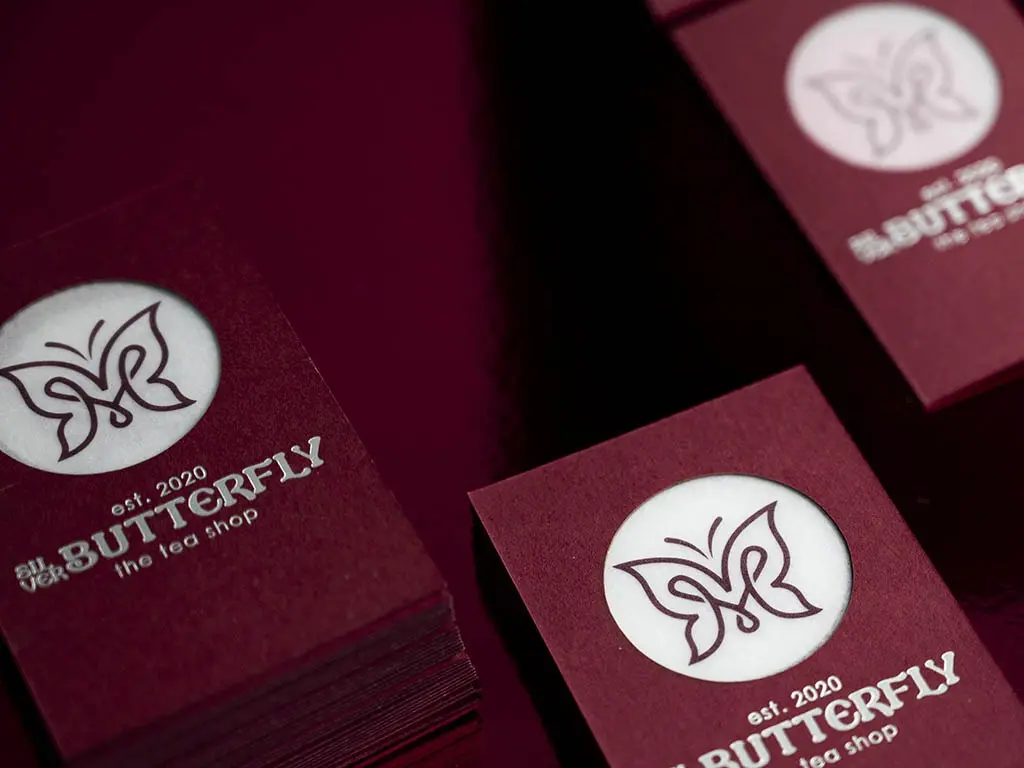
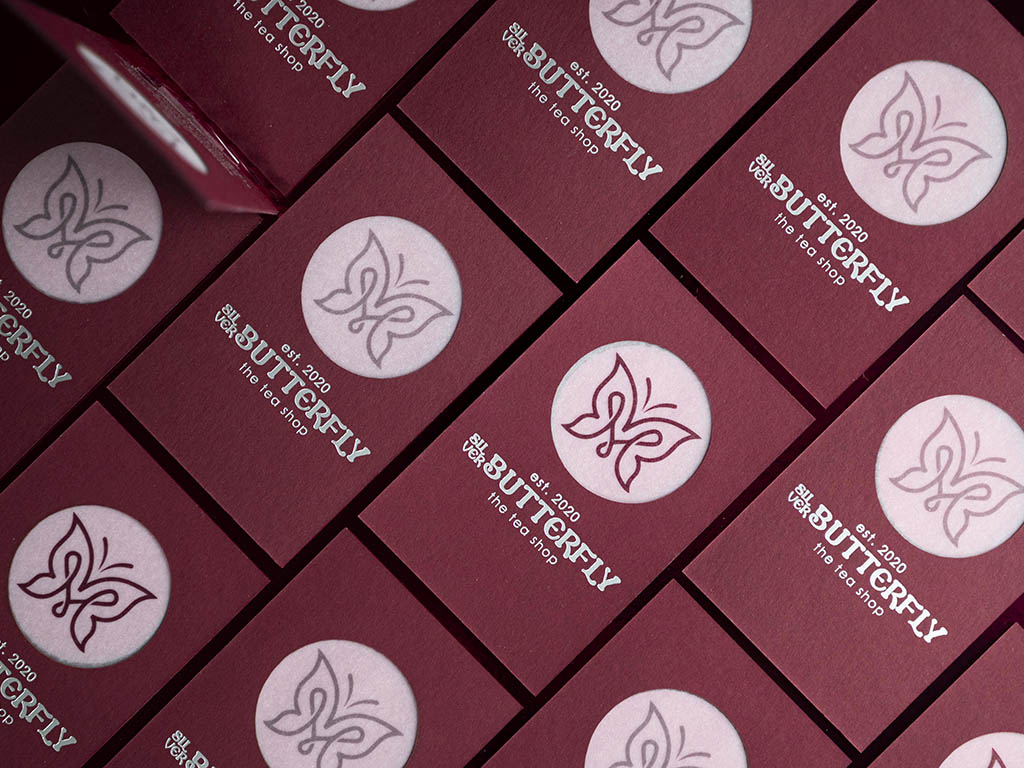
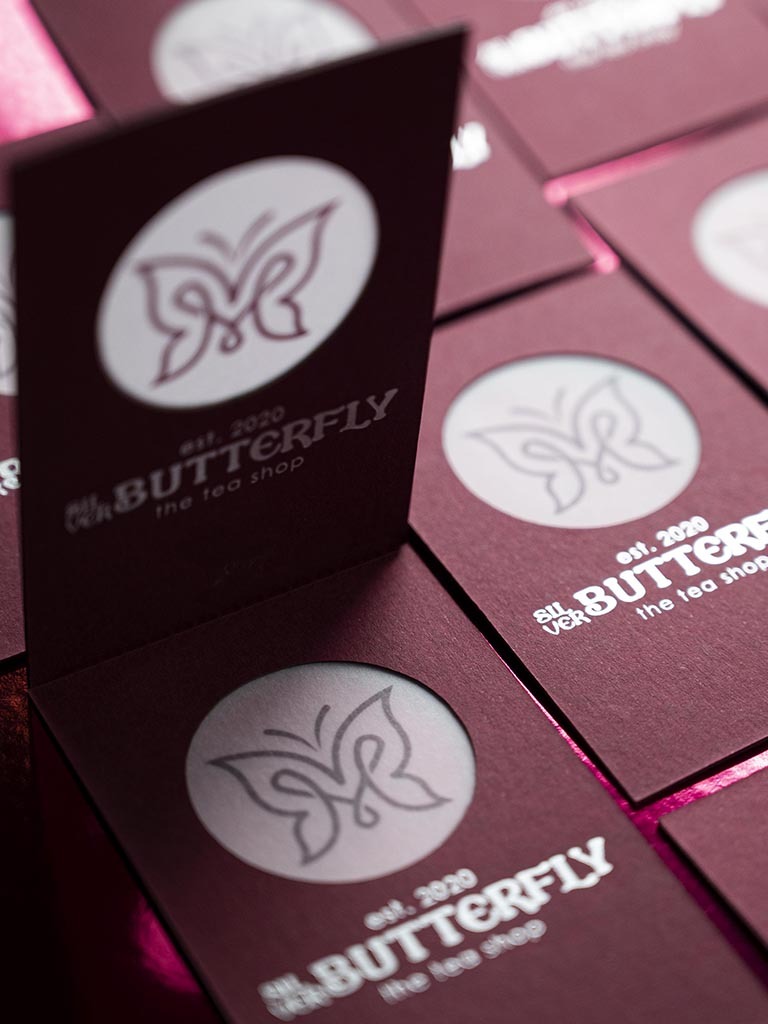
Laser-cut Triplex business cards join two coloured outer papers around a Curious Translucents Clear 160 gsm centre. A controlled internal cut in each outer face reveals the Pantone-printed middle layer, while one selected hot-foil colour carries the main information across both outer faces.
- Outer papers
- Colorplan 270 gsm, Keaykolour 300 gsm or Materica 360 gsm
- Centre
- Curious Translucents Clear 160 gsm with one Pantone colour
- Foil
- One selected hot-foil colour on both outer faces
- Laser cut
- One simple internal window in register across the outer layers
- Profile
- Square corners and an unpainted edge
- Production
- 7–12 working days after artwork approval
HOW THE THREE LAYERS WORK
The middle sheet is part of the image—not only a coloured edge.
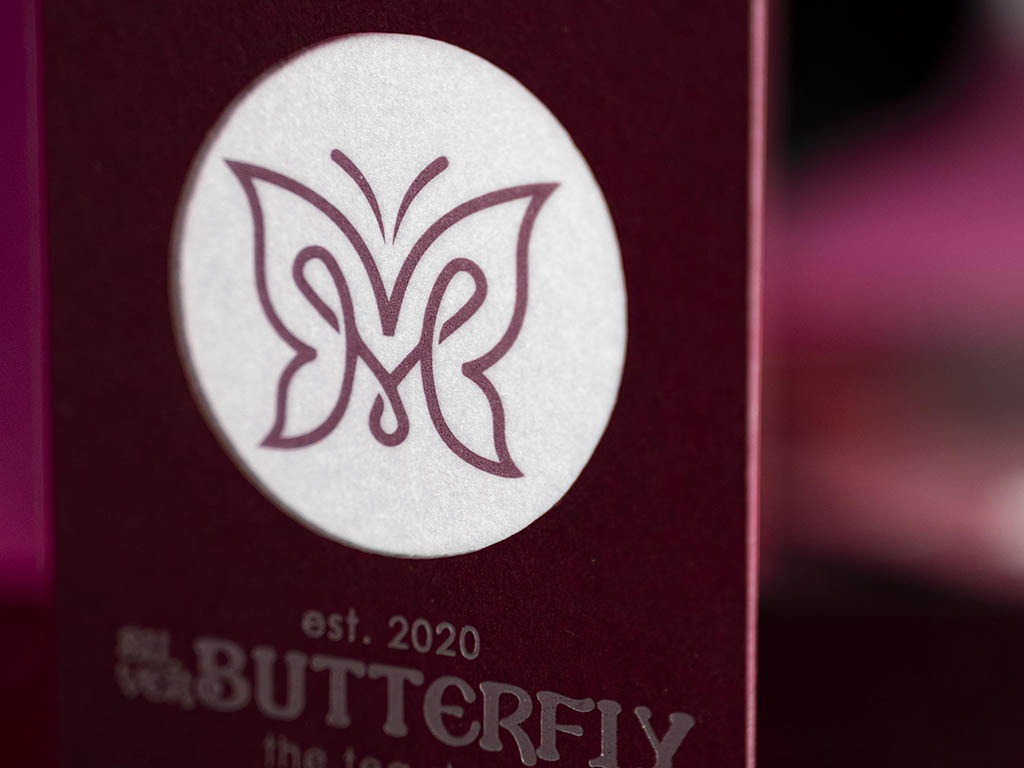
The translucent layer carries one Pantone colour. It becomes visible through the aligned cut-out in the outer papers, letting the design use opacity, translucency and depth in the same small object.
The two outer sheets provide the principal colour and tactile surface. Bonding all three layers produces a substantial card whose edge reveals the translucent centre between the coloured faces.
Included online specification
- One paper family and one outer-paper colour.
- The same paper and colour on both outer faces.
- One Pantone colour on the translucent centre.
- One simple internal laser-cut window.
- One foil colour applied to both outer faces.
LASER-CUT WINDOW DESIGN
The opening does not have to be circular—but every shape needs tolerance.
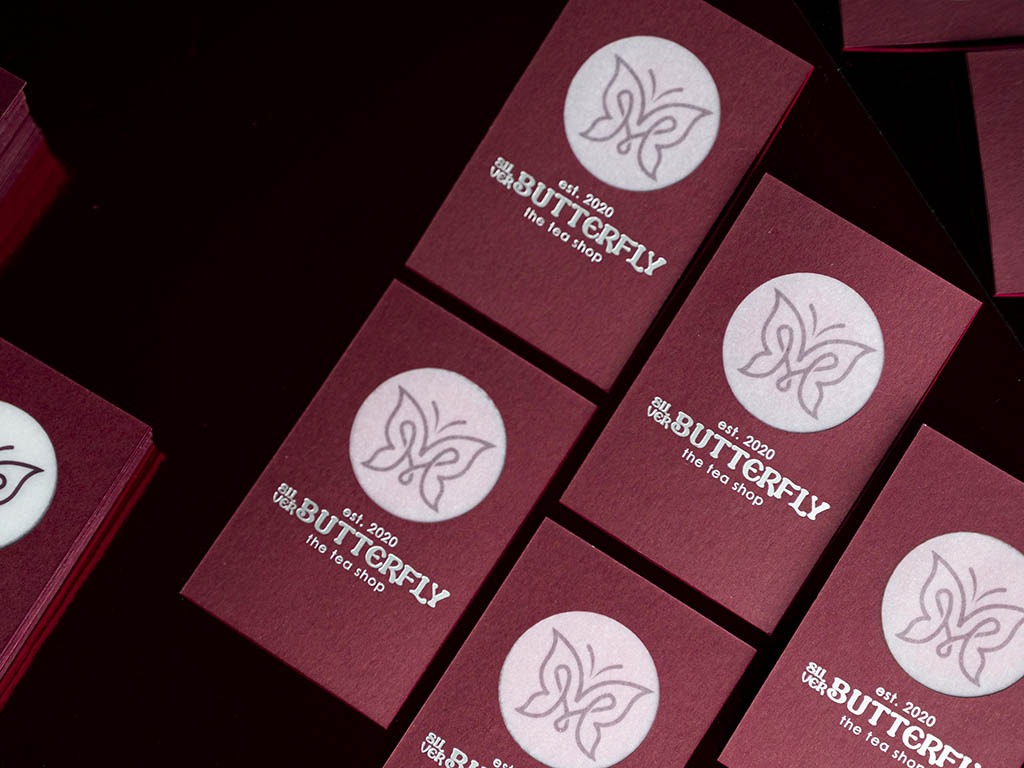
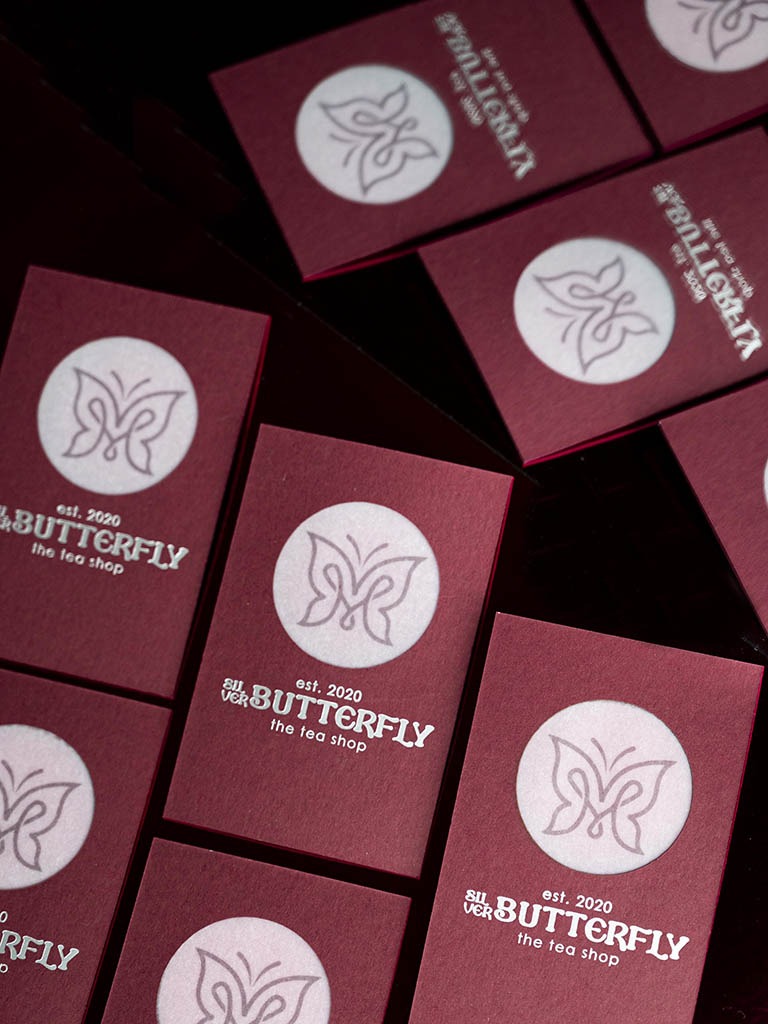
The Butterfly sample uses a circle because a rounded, non-directional opening disguises small registration movement particularly well. It is an example, not a restriction. A simple geometric, organic or brand-related internal shape can work when it leaves enough paper around the opening and avoids fragile points or very narrow bridges.
Printing, laser cutting and bonding three separate sheets cannot guarantee mathematically perfect registration between both outer windows and the artwork on the translucent centre. The file must therefore be designed so that a small normal movement does not change the intended result or appear as an error.
Design for normal registration movement
- Keep important parts of the centre graphic comfortably inside the visible opening.
- If colour should fill the window, extend it beyond the cut path so movement cannot reveal an unintended unprinted sliver.
- Do not design a fine printed outline that must meet the cut edge exactly.
- Circles and softly rounded shapes conceal small shifts better; sharp corners and closely matched outlines make them easier to see.
The centre artwork is mirrored from the reverse.
The Pantone artwork is printed on one translucent sheet and viewed through openings on both faces. From the reverse face, the same artwork appears as a mirror image: letters and other directional details will read backwards. Design the centre graphic so both views look intentional. Symmetrical marks, silhouettes and abstract forms are usually more suitable; if both faces must carry independently readable centre artwork, request a Bespoke Quote before designing the file.
COLOUR & LASER CUTTING
Why pale outer papers are excluded from this product.
Laser cutting darkens the paper at the cut line. On deeper colours, that warm scorched edge becomes controlled and comparatively quiet. On white and pale papers it remains much more visible and can look like contamination rather than an intentional detail.
For this reason, the online selector contains reviewed mid-tone and deep shades only. Other colours can be considered through a Bespoke Quote after a material and artwork check.
PAPER FAMILIES
Three distinct surface characters.
Colorplan offers the broadest colour system and a controlled uncoated face. Keaykolour adds natural grain and useful bulk. Materica is rougher and visibly fibrous, with mineral and earth-led colours.
ARTWORK PREPARATION
Three processes need three clearly separated files or layers.
Supply the hot-foil artwork, Pantone artwork and laser-cut path as separate vector layers at final size. The cut path must be a closed vector shape and must not touch the outer trim. Foil and printed detail need appropriate clearance from both the cut window and the edge of the card.
The artwork review checks registration, minimum detail, cut complexity, contrast and the way the window reads on both faces before production begins.
Route more complex work to review
Multiple windows, very fine lace-like cutting, perimeter shapes, different outer papers on each face, more than one foil, more than one Pantone colour or unusually large foil coverage require a Bespoke Quote.
DESIGN STUDY
See the exact Butterfly sample behind this product family.
The Butterfly house sample uses Keaykolour Carmine, matt silver foil, one Pantone colour and a circular internal laser cut. The Design Study documents how those choices work together without turning one sample into the limit of the configurable product.
RELATED GUIDANCE